Ten lessons to teach your children about money

Ten lessons to teach your children about money

Ten lessons to teach your children about money

When it comes to teaching your children about money there are some lessons that can’t be taught in the classroom. During global lockdown, this may be a good opportunity for them to learn about managing their finances.

1.Budget to save
Today’s school-age children are facing a long wait to get on the property ladder and to retire.  We recommend getting them into the habit of saving and budgeting as early as possible, so they are prepared for these milestones.

2. You only spend it once
Children need to understand the value of money.  There are now apps and prepaid cards that can be used for purchases and monitored by parents.  This will gradually introduce them to an increasingly cashless society.

3. Needs vs wants
It is important to help children decide when to spend now and how to budget in later life.

4. Money is earned
Don’t give pocket money without requiring your child to do something for it.

5. Save to give
Children are naturally generous.  Being able to give some of their pocket money to charity may be an incentive for them to save more.

6. Paper vs plastic
Just because you can’t see the money when using a card, it doesn’t mean that it isn’t being spent.  Explain the difference between a credit and debit card and how the money in a current account is just like paper money.

7. Keep half, spend half
A good mantra is, “keep half, spend half.  This is something children can apply now, as they do not have the large outgoings adults may have.  If they carry this principle into adulthood, it will transform their life financially.

8. Avoid peer pressure
Stress the importance of making healthy choices with money and life in general.  Look at social channels and point out how things are manipulated, how ‘influencers’ are paid to sell products.

9. Compound interest
Described as the eighth wonder of the world by Albert Einstein.  It is important to teach children about the effects of compound interest.

10. Prepare for the unexpected
The latest virus pandemic has shown us all how important it is to have savings for a rainy day. Building on good financial health helps deal with all types of events both good and, not so good.

By Philip Harper  |  April 2020

Enquiry form

When you press SUBMIT, you voluntarily choose to provide personal details to us via this website. Personal information will be treated as confidential by us and held in accordance with General Data Protection Regulation. You agree that such personal information may be used to provide you with details of services and products in writing, by email or by telephone.

Navigating the turbulent seas of fortune

Navigating the turbulent seas of fortune

Anyone who reads the papers knows that the world’s economies are going through a period of uncertainty. It’s natural at these times for some investors to get twitchy, which only serves to make
the situation even less predictable.

The truth is that share prices invariably rise and fall, but for the long-term investor, this shouldn’t need to be the primary concern. Historically, long-term performance tends to even things out and there are even good reasons to see opportunity where other investors are seeing only gloom.

The world of investing is overflowing with metaphors, adages and fables, so here are our top seven principles for keeping your head when all about you are losing theirs.

Investing can feel like a hazardous voyage particularly during turbulent times. This is when our horizon can veer towards the shorter term, we have selected three of our principles to focus on that are particularly relevant to current market conditions.

Stay invested: The perils of missing the best days
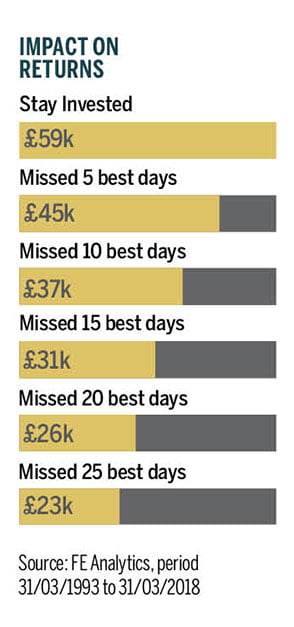
When markets are volatile, it is often tempting to exit the market or switch to cash in an attempt to reduce further expected losses. However, it is impossible to time these movements correctly as no-one has a crystal ball to predict future movement, so being out of the market for just a few days can have a devastating effect on returns. Using UK equities as an example, the chart (right) shows how missing just a few of the best days can have a devastating impact on returns.

Over the last 25 years, using the example of a £10,000 initial investment, an investor who stayed in the markets throughout the period could have a potential return of more than double that of an investor who missed the best 25 days.

Invest for the long-term: Our proposition rewards the patient investor
Wise investors know that investing is a long-term commitment. Historically, investors who have been able and willing to ride out the periods of decline in the markets have seen their investments recover. Investing with a long-term outlook and with long-term goals is the best way to reduce the impact of stock market fluctuations and see out periods of volatility. Taking the last 25 years, there have been many examples of short-term volatility but over the long term the trend is a rising one.

Steering a course towards a longer-term investment horizon will always require a steady hand on the tiller in the shorter term. These fundamental principles are a useful reminder of the strategies that will continue to benefit our clients.

Don’t just invest in cash: The eroding power of inflation
It is often tempting to see cash as a safe haven against all market volatility. However, recent years have seen higher rates of inflation and lower rates of interest on your cash. The pressure that inflation can place on your cash can be very debilitating and in the long run not being invested in the markets can be inherently riskier than being invested.

At just 2.5% inflation, an investor would lose nearly half of their purchasing power over 25 years. So, £10,000 today would only have the purchasing power of £5,310 in 25 years’ time.

Interest rates have always historically outstripped inflation. Investing in a standard interest-bearing bank account would have provided some protection against the ravages of inflation. However, looking forward interest rates are expected to stay below inflation.

By Philip Harper  |  March 2020

Not all gifts at Christmas need to be wrapped up

Not all gifts at Christmas need to be wrapped up

Not all gifts at Christmas need to be wrapped up

A common question from our clients: If I give money to my children, will they be taxed on it?There is a misconception that you cannot give more than £3,000 in any tax year, but this is not the case. The fact is you can give any amount without triggering any kind of tax charge. Where a tax implication does arise is if the person giving the gift dies within the seven-year period from the date of the transaction.It is however vital to understand that if death does occur within this 7-year period, no tax charge will be incurred by the children nor will they have to return the gift. All that happens is all or part of the gift will be nominally brought back into the estate for the purpose of calculating any inheritance tax liability. Gifts from income may be deemed as immediately outside an estate if the amount given does not have a detriment impact on the value of the donor’s estate. In other words, gifts from ‘surplus’ income.For those concerned by the seven-year rule, there are other opportunities available.Business Relief (BR) is the name given to a tax incentive where the government allow the value of an investment to be deemed outside of an individual’s estate after the investment has been held for just two years (and still held at date of death). This is becoming a very popular method of inheritance tax planning, the main attraction being the investment stays in the investors control, so no gifting takes place and here are the other features:Speed – Inheritance tax benefits are achieved if BR qualifying assets of investments are held for just 2 years at date of death. Control – Investor retains control of and access to their investments. Flexibility – Options for survivor on partner’s death. Simplicity – No legal structures or medical underwriting. Although this type of opportunity is not new, historically the investment content has leaned towards the higher end of the investment scale and this has never been particularly appealing to investors in retirement. We now however have access to lower risk products which aim to target capital preservation, which is how this sector has now become so popular with investors looking to mitigate against inheritance tax.
By Philip Harper  |  November 2019

Enquiry form

When you press SUBMIT, you voluntarily choose to provide personal details to us via this website. Personal information will be treated as confidential by us and held in accordance with General Data Protection Regulation. You agree that such personal information may be used to provide you with details of services and products in writing, by email or by telephone.

Wycombe Sound radio’s interview with Vanessa

Wycombe Sound radio’s interview with Vanessa

Wycombe Sound radio’s interview with Vanessa

Chris Phillips, afternoon show presenter quizzed Vanessa on many aspects of this increasingly mainstream area of lending. With interest rates now below 3% fixed for life, far from being a last resort, Equity Release has become an essential option to consider when looking to fund anything from creating a more comfortable retirement, to paying off an interest only mortgage, to helping family get on the property ladder, rather than a last resort.

Vanesa's radio interview

by Vanesa Carver | Wycombe Sound radio

Enquiry form

When you press SUBMIT, you voluntarily choose to provide personal details to us via this website. Personal information will be treated as confidential by us and held in accordance with General Data Protection Regulation. You agree that such personal information may be used to provide you with details of services and products in writing, by email or by telephone.

Money – why it’s good to talk

Money – why it’s good to talk

Money – why it’s good to talk

Do you discuss your finances with your nearest and dearest? In many families, having a frank discussion about wealth still remains a taboo
Please contact us if you require a copy of our When I’m Gone Guide, available as a hard copy or electronic.
However, with younger people needing to learn the money management skills that will stand them in good stead throughout their lives, and the older generation often requiring help with their finances in their later years, it’s important for children and parents of any age to be able to communicate effectively about family wealth issues.Overcoming the barriers Some families find it difficult to discuss wealth. It’s not uncommon even today for married couples not to know how much money their spouse earns. Well-off parents can sometimes shy away from letting their children know too much about their wealth, in an effort to prevent them becoming complacent about what they might inherit in the years to come and losing their work ethic. Older people don’t always like to dwell too much on the future, finding it difficult and distressing to raise issues about death and inheritance with their loved ones. However, taking the time to discussimportant financial matters with other family members will help to ensure the right financial plans are in place to safeguard family interests.Here to help Openly discussing wealth matters with your family can help establish priorities, clarify goals and ensure plans are put in place to support each generation according to their financial needs. We are increasingly being asked to be part of these conversations, not least because it’s often easier to start the conversation with the help of a third-party professional to help get over the possible awkwardness of how to start the conversation.…taking the time to discuss important financial matters with other family members will help to ensure that the right financial plans are in place to safeguard family interestsMany people believe that establishing an up-to-date Will is all that needs to be done to put in place financial arrangements, however this is often only focuses on the major formalities of estate planning.Communication is key and our “When I’m Gone” Guide deals with the softer aspects of one’s estate. It can be the starting point towards a more open understanding with the family and hopefully leading to an appropriate outcome for all.

By Philip Harper  |  July 2019

Enquiry form

When you press SUBMIT, you voluntarily choose to provide personal details to us via this website. Personal information will be treated as confidential by us and held in accordance with General Data Protection Regulation. You agree that such personal information may be used to provide you with details of services and products in writing, by email or by telephone.

The lesser-known way to cut the tax on your family estate

The lesser-known way to cut the tax on your family estate

The lesser-known way to cut the tax on your family estate

Investment gains and dividends received within an ISA are not subject to tax. While, not officially part of the ISA family, Inheritance ISAs have become a popular way of preserving wealth for the next generation. They launched in 2013, when the rules changed to allow savers to invest in smaller companies quoted on the Alternative Investment Market (AIM) through their stocks and shares ISA.Shares in some companies quoted on AIM can be passed on free of inheritance tax (IHT) under a scheme called Business Relief (BP). If you hold shares in companies eligible for BP for at least two years and still held at date of death, your estate will not have to pay inheritance tax on their value.The estate of someone with £100,000 worth of stocks and shares in ISAs, plus a house and other assets above the £325,000 limit, they would incur a £40,00 tax charge on their portfolio. If that person had their shares in an AIM IHT Stock and Shares ISA for at least two years, there would be no charge. The combination of investment growth free of tax within the ISA plus the opportunity to pass on wealth tax free, has proved a winning combination.The government are quite stingy with offering tax breaks to us and we therefore recommend clients try to take advantage of those that are available.The government does not provide a list of companies eligible for BR, so many savers prefer to use investment managers whom pick companies likely to qualify. These portfolios are quite high-risk investments and savers need to be happy that there is going to be volatility involved. For example, Octopus Investments, a BP manager, fell in value 20% last year but over the past five years it has risen 52%. We will remind clients that positive ISA returns are awarded to the patient investor.It is also important to keep an eye on charges, not only performance. AIM investing is more expensive than investing in the main markets because there is more legwork involved for managers, but some companies charge high fees, which need to be justified. It’s also worth being reminded that married couples can inherit each other’s ISA portfolios on death, meaning the portfolio remains intact and can continue to deliver tax free income to the surviving partner.
By Philip Harper  |  March 2019

Enquiry form

When you press SUBMIT, you voluntarily choose to provide personal details to us via this website. Personal information will be treated as confidential by us and held in accordance with General Data Protection Regulation. You agree that such personal information may be used to provide you with details of services and products in writing, by email or by telephone.

Thank you

Terms of Business Accepted and Acknowledged

The form has been submitted

Thank you for this confirmation to invest additional funds to your General Investment Account. We will confirm the bank account to transfer the funds and a reference number. Once the top up has been applied to your tax-free investment account, the Client Support Team will confirm this and provide you with an updated valuation.

The form has been submitted

Thank you for this confirmation to invest additional funds to your ISA. We will confirm the bank account to transfer the funds and a reference number. Once the top up has been applied to your tax-free investment account, the Client Support Team will confirm this and provide you with an updated valuation.